


18th November 2025
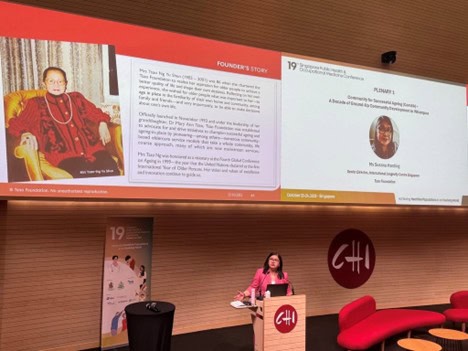
The 19th Public Health and Occupational Medicine (PHOM) Conference was held on 23-24 October 2025 in Singapore, attended by Ms Susana Concordo Harding, Senior Director of the International Longevity Centre Singapore (ILC-S), Tsao Foundation.
At the conference, Ms Susana Concordo Harding offered keynote insights and panel reflections that underscored a central theme: Singapore’s ageing future will be shaped not only by healthcare advancements, but by community strength, individual capability and supportive care systems.
Her contributions closely aligned with the International Longevity Centre Global Alliance (ILC-GA)’s global vision of promoting healthy, empowered and purposeful longevity for all spotlighting ageing as a social asset that, when nurtured, strengthens society.
In Plenary 1, Ms Harding highlighted the Community for Successful Ageing (ComSA) model as a decade-long demonstration of ageing as a community achievement. She described how health coaching, peer leadership, lifelong learning and intergenerational engagement have transformed Whampoa into a “living laboratory” where older adults are recognised as contributors with agency and purpose. This community-rooted approach reflects ILC-GA’s belief that longevity flourishes when systems, families, institutions and neighbourhoods work together and when older adults are viewed not as dependents, but as partners in building vibrant, age-inclusive communities.
In the WELL Continuum panel, Ms Harding emphasised that wellness in later life is shaped across the entire life course. Social ties, emotional resilience, financial security and supportive environments accumulate over decades to influence population health outcomes. She highlighted person-led, relationship-centred and place-based approaches that strengthen neighbourhood cohesion long before older age. This life-course framing echoes ILC-GA’s call for nations to design policies that support resilience, contribution and well-being from adulthood through later life.
During Plenary 4, Ms Harding addressed the urgent need for integrative population health systems that respond to both medical and social determinants. She underscored three priorities: integrating preventive care with the Bio-Psycho-Social (BPS) approach; recognising communities as essential health assets; and treating caregiving both paid and unpaid as critical social infrastructure. These themes reflect ILC-GA’s advocacy for building age-inclusive, community-anchored health systems that uphold prevention, social networks and strong caregiver protections.
Across all sessions, Ms Harding’s reflections aligned with vision of “Living Well Together in an Ageing Singapore”, inspired by the African humanist principle Umuntu ngumuntu ngabantu (“I am because we are”). This vision positions ageing as a collective journey grounded in interdependence, mutual responsibility and stronger social bonds across generations. As Singapore digitalises, society must remain globally connected yet locally rooted ensuring older adults have access to technology, digital literacy and opportunities to participate meaningfully in a connected world, so longevity does not lead to digital exclusion. At the same time, Singapore must grow stronger and more adaptive, building resilience, inclusive policies and robust community networks in line with ILC-GA’s belief that ageing societies can become more cohesive, innovative and future-ready.
Ms Harding’s contributions reaffirmed that ageing is not a challenge to be managed but a shared opportunity to build a society where people of all ages can thrive, connect and contribute.

A Shared Vision for Global Longevity of Rayne and Susana (newly elected Co-Presidents)
It is a profound honour to serve as Co-Presidents of the International Longevity Centre Global Alliance. Our partnership reflects the very spirit of the Alliance: global in reach, grounded in local realities, and united by a shared commitment to dignity, equity, and wellbeing across the life course.
27th January 2026
VNRs of HLPF at the UN: The 2030 Agenda for Sustainable Development
Voluntary national reviews (VNRs) were held at High-Level Political Forum on Sustainable Development (HLPF) from 14 to 24 July 2025, UN, New York. Each State shared Experiences and Lessons on the 2030 Agenda and SDGs implementation.
24th July 2025
The Intersectionality of Ageism & Sexism: Harnessing The Power of Older Women
During the 2025 UN High Level Political Forum, the ILC Global Alliance and partners hosted a side event to address the intersection of ageism and sexism, advocating for a UN convention to protect the rights of older persons.
16 July 2025
